Apapaxoa 2026: Stories with Flavor That See Gastronomy Differently
September 20, 2026
At Apapaxoa, gastronomy does not always begin in the kitchen. Sometimes, it begins with a question.
What can artificial intelligence teach us about our own ability to think? What does it mean for food to be alive? What do colors taste like? Where does a liqueur end and a spirit begin? Can a memory become a dish?
During Apapaxoa 2026, chefs, scientists, artists, and creators gathered around these questions to explore gastronomy through territories that extend far beyond the table. These were conversations in which cooking also meant thinking, remembering, experimenting, and questioning.
Martha Ortiz and Pamela Cerdeira: What Is Artificial Intelligence Hungry For?
Fire and artificial intelligence have more in common than we might imagine: both are tools capable of transforming whatever they touch, but their true value depends on the people who use them.
In this conversation, chef Martha Ortiz and journalist Pamela Cerdeira explored the uses, risks, and possibilities of artificial intelligence through a provocative question: what is artificial intelligence hungry for? And along the same lines, what are we feeding it?
The conversation took the discussion into deeply human territory. If a tool can produce increasingly sophisticated answers, what is it that we, as humans, must preserve?
For Martha Ortiz, one of the keys lies precisely in our ability to think, question, and make decisions.
> “A humanity that stops thinking is a humanity that will not flourish,” the chef remarked.
Artificial intelligence can help us create, research, and solve problems. But taste, judgment, and the ability to decide what should remain and what should disappear are still deeply human.
There was also room to talk about error: that “controlled disfluency” that introduces a small imperfection and, with it, the possibility of discovery.
Because perhaps trust does not come from perfection, but from knowing that we can still make mistakes.
In this sense, doubt and curiosity emerge as two of the most valuable tools for engaging with artificial intelligence without allowing it to think for us.
The Modern Culture of Cocktails: When a Spirit Becomes a Conversation
The story of a good drink can also be the story of a culture.
In The Modern Culture of Cocktails, Erick Van Beek and José Luis Hinostroza took the audience on a journey that began with a seemingly simple question: what exactly is a liqueur, and how is it different from a spirit?
From there, the conversation became an exploration of the history, technique, and evolution of contemporary mixology.
The gathering also marked a new chapter for Handshake, evolving into Handshake Cariño, a proposal that draws on accumulated knowledge to open a new conversation around hospitality and cocktails.
Rather than focusing solely on beverages, the talk offered an opportunity to understand how ingredients, techniques, and ideas also evolve over time.
The Fermentista of Mérida: When Food Is Alive
There is something fascinating about fermentation: it is never completely finished.
Chemist and fermentation specialist Esteban Rojas shared a perspective on the processes that transform food and beverages into constantly evolving organisms.
His starting point was simple, yet revealing: fermented food is alive. And precisely because it is alive, it changes.
Something that tastes one way today may taste different tomorrow. Transformation is not a flaw in the process; it is part of its nature.
The conversation also traveled back in time to explore some of the fermentation processes used since ancient times and understand how these practices were fundamental to the development of different civilizations.
Long before fermentation became a gastronomic trend, it was already part of how different cultures preserved, transformed, and understood their food.
In that sense, looking at fermentation is also looking at one of humanity’s oldest technologies.
When Color Has a Flavor
What do colors taste like? The question seems impossible until you meet Gaby Ruiz. From an early age, the chef has possessed a remarkable ability: finding flavor in sounds and colors.
Gaby Ruiz lives with synesthesia, a condition that can cause stimuli experienced through one sense to also be perceived through another. In her case, colors and sounds can become flavors.
This particular way of perceiving the world has also become a creative tool. Gaby Ruiz has brought this relationship between the senses into her cooking and has even “cooked songs” for different artists.
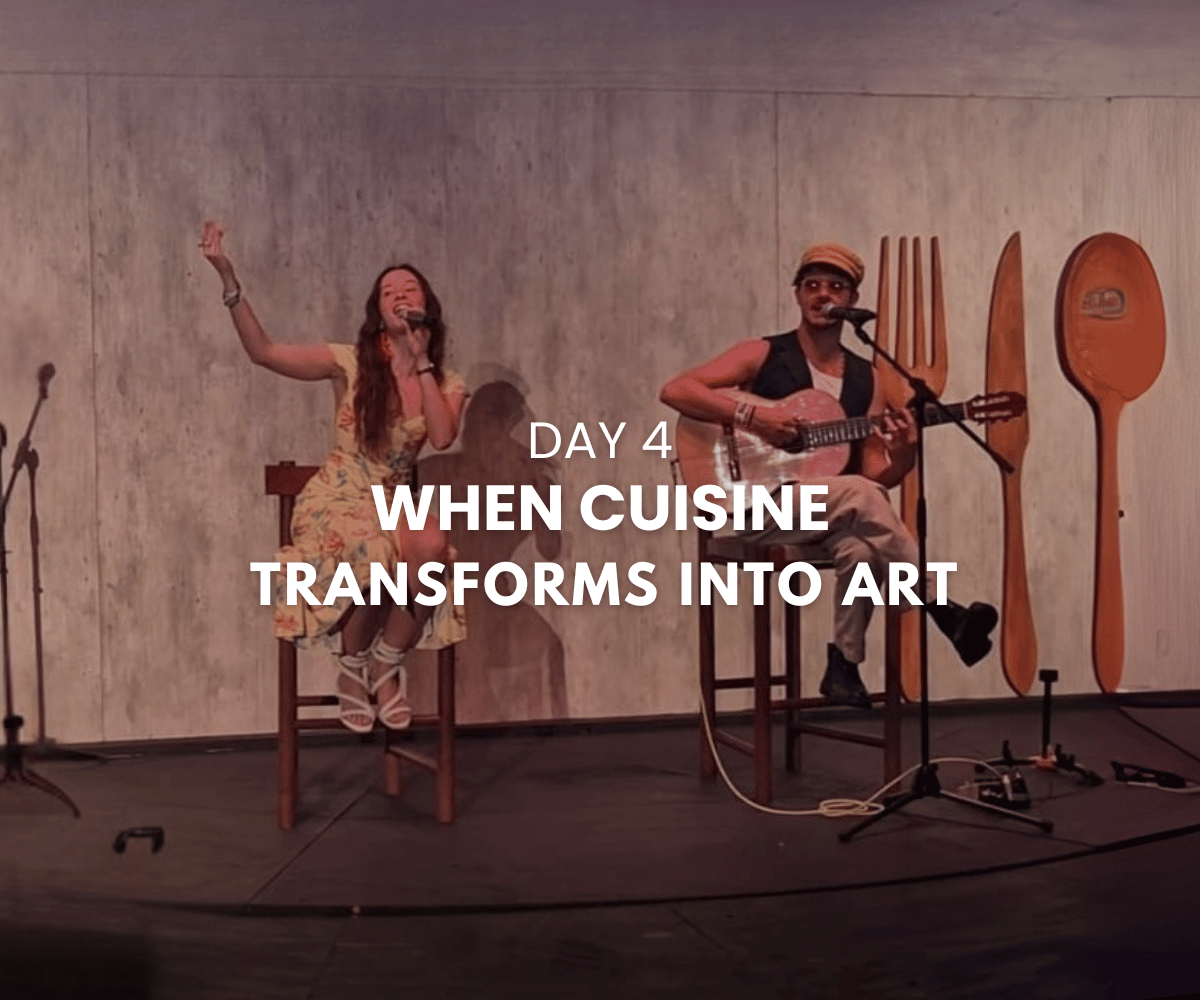
At Apapaxoa, music took the stage alongside Benny Ibarra, who performed several of his songs while the audience took part in a gastronomic experience built around chocolate, the flavor Gaby chose to accompany the encounter.
Beyond the experience itself, the conversation opened up an intriguing possibility: thinking of synesthesia not only as a perceptual condition, but as a reminder that each person can discover unexpected connections between what they see, hear, touch, smell, and taste.
A reminder that sometimes, creating means finding relationships we had never imagined before.
From the Mediterranean to the Amazon: Cooking from Memory
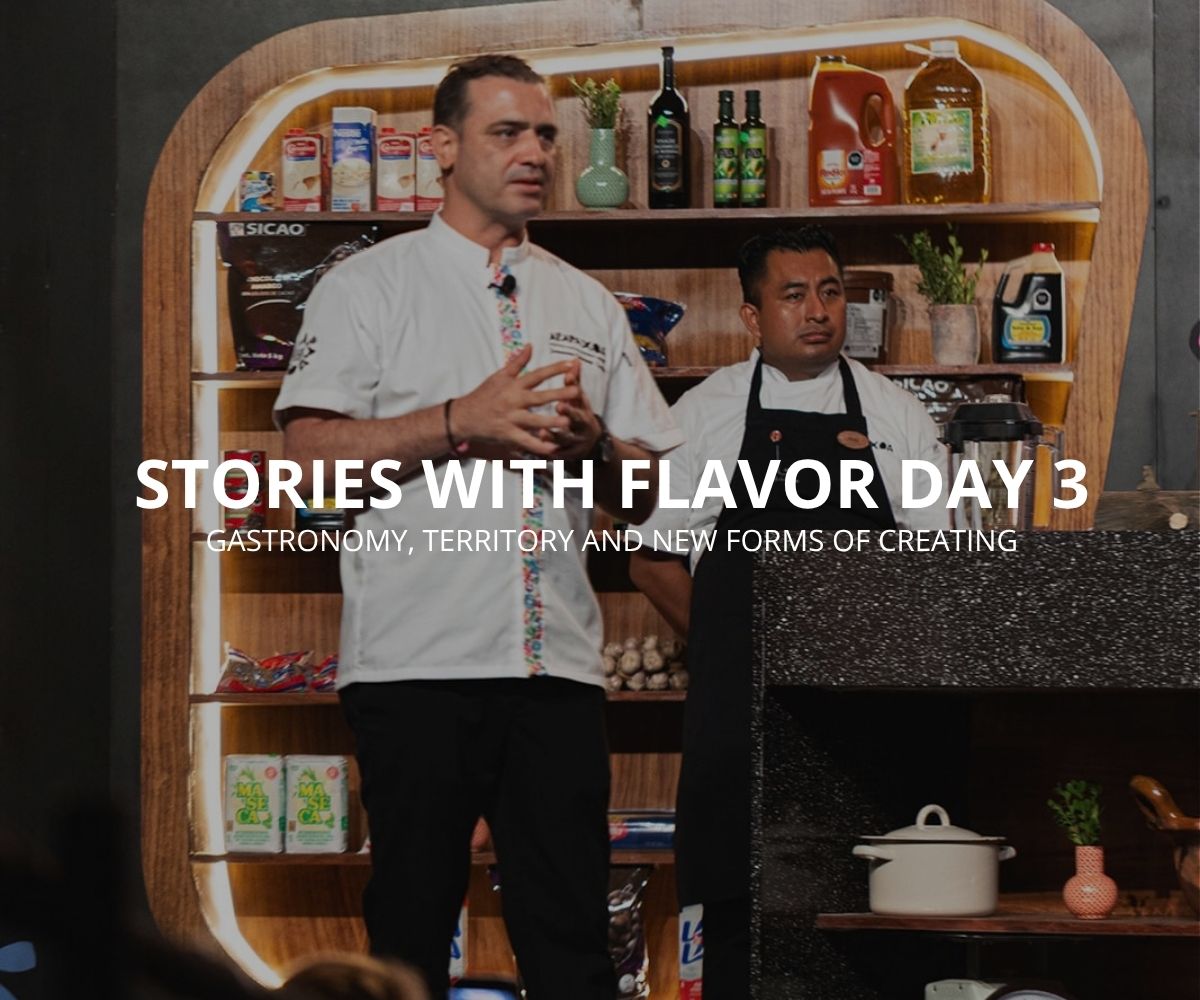
In this story, three chefs with different backgrounds and geographies—Quique Dacosta, Álvaro Clavijo, and Jonatan Gómez Luna—shared some of the ideas that have shaped the way they cook and understand a restaurant with the Apapaxoa audience.
Quique Dacosta, who visited Apapaxoa for the first time, brought a cuisine deeply connected to memory to the stage. Through a live demonstration, he prepared a series of dishes inspired by experiences and memories that have accompanied him throughout his career, showing how an ingredient can also become a way of speaking about a place, a story, or a moment.
From Colombia, Álvaro Clavijo, chef of “El Chato,” spoke about a philosophy deeply rooted in his territory: working with the Colombian ingredient as a starting point. His cuisine seeks new ways of expressing local flavors. But for Clavijo, a restaurant’s identity is not built solely in the kitchen. At “El Chato,” creativity also involves pastry, the dining room, and every area involved in service. His proposal combines a tasting menu with a more accessible à la carte offering, seeking to make the flavors of Colombia’s own territory more accessible to people across the country.
Jonatan Gómez Luna, chef of “Le Chique,” brought the conversation toward another essential aspect of a restaurant’s identity: the people who build it. His philosophy is rooted in a clear idea: hire from within and grow alongside the team. For Jonatan, for a restaurant to function as a whole, the people who are part of it must evolve with the project. That continuity makes it possible to build a shared vision that extends from the kitchen to the service.
During the demonstration, he presented a dish inspired by “the ages of the coconut,” using contemporary techniques such as liquid nitrogen to create a kakigori and coconut aguachile emulsions. The preparation also reflected another part of his philosophy: creativity is nourished by what we learn from others. Techniques, ideas, and knowledge shared by chefs such as Quique Dacosta and Álvaro Clavijo can also find new life in his own kitchen.
The gathering concluded with international recognition for Le Chique: its inclusion in the Dom Pérignon Society, making it the first restaurant in Latin America to receive this distinction.
Three chefs. Three territories. Three ways of understanding cuisine.
Different Conversations, One Shared Curiosity
Artificial intelligence, cocktails, fermentation, synesthesia, and memory might seem like distant subjects. At Apapaxoa, they found common ground.
All of these conversations began with something that sounds simple, but actually requires a certain kind of courage: to keep asking questions.
To ask what we can do with a new tool. To ask what it means for food to be alive. To ask how we perceive flavor. To ask where what we drink comes from. To ask how a memory can become food.
When gastronomy is no longer limited to what happens on a plate, new ways of understanding it begin to emerge.
And perhaps that is one of the most interesting conversations Apapaxoa 2026 left us with: curiosity can also be an ingredient.

Especialista en estrategia de contenidos SEO apasionado por la cultura, tradiciones y biodiversidad ...

Related posts



Parks


Tours



Xcaret Xailing


Hotel





Grupo Xcaret
Hotels
Xcaret - Mexico, Chetumal - Puerto Juarez Federal Highway, Km. 282, Rancho Xcaret,Playa del Carmen,Quintana Roo. México. CP 77710.
Telephone USA/CAN: 1-855-326-0682 Open Monday to Friday from 7:00 a.m. at 12:00 a.m. | Saturdays and Sundays from 7:00 a.m. at 10:00 p.m. Quintana Roo local time.
©Copyright 2022 Experiencias Xcaret Parques, S.A.P.I. de C.V
